

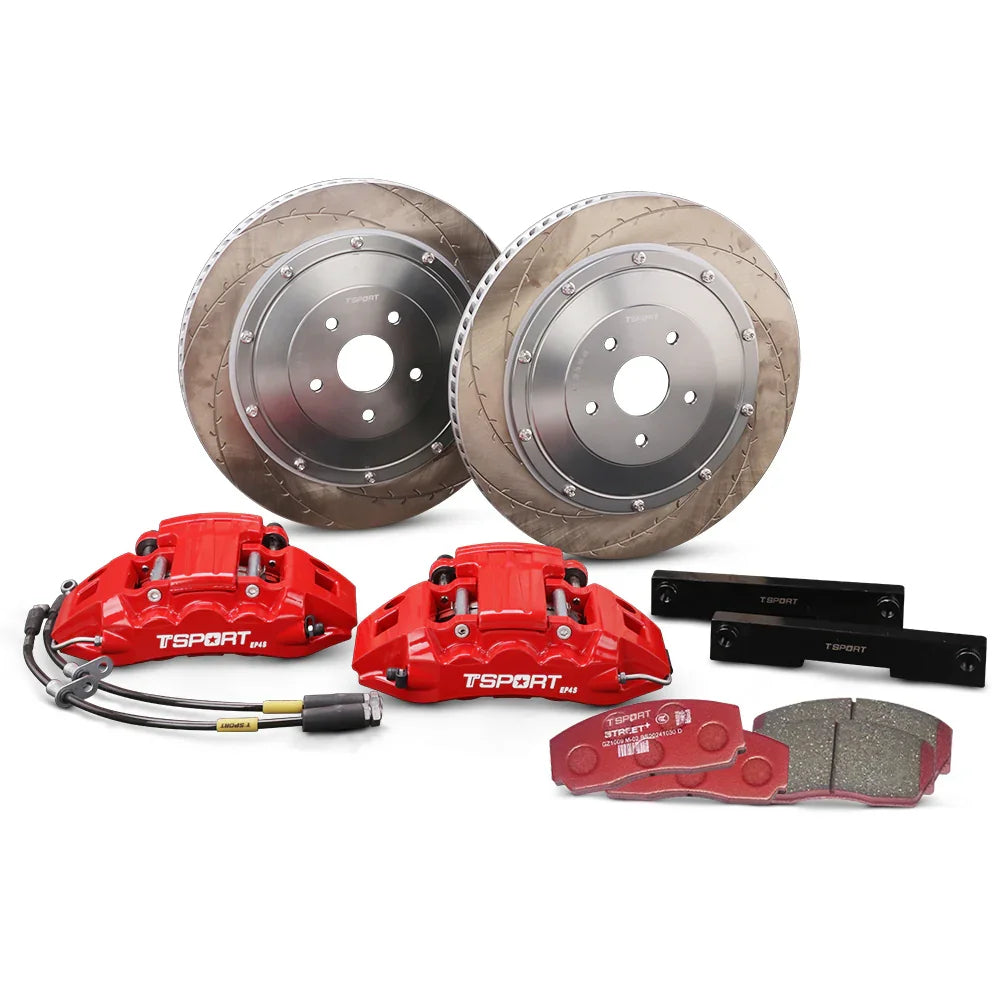


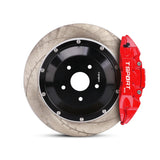
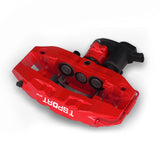
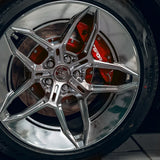


ลูกสูบไฮดรอลิก 4 ตัว + ตัวขับเคลื่อน EPB
ลูกสูบไฮดรอลิกขนาด 28 มม. สี่ตัวขับเบรก pads ควบคู่กับลูกสูบตัวขับเคลื่อน EPB ขนาด 27 มม. ซึ่งรักษาเบรกมือไฟฟ้าจากโรงงานไว้
ซีรีส์ Evolution · เพลาหลัง · เข้ากันได้กับ EPB
ชุดเบรกใหญ่ล้อหลัง EP4S ถูกออกแบบมาสำหรับแพลตฟอร์มสมัยใหม่ที่ยังคงต้องการเบรกจอดอิเล็กทรอนิกส์ ชุดลูกสูบบริการไฮดรอลิกสี่ตัวรับภาระการหยุดรถ ในขณะที่ลูกสูบตัวขับเบรกจอดอิเล็กทรอนิกส์ (EPB) ที่ออกแบบมาเฉพาะช่วยรักษาฟังก์ชันเบรกจอดจากโรงงาน — เพื่อให้คุณได้ความสามารถในการระบายความร้อนของล้อหลังจริงโดยไม่สูญเสียความสะดวกสบายแบบ OE
ลูกสูบไฮดรอลิกขนาด 28 มม. สี่ตัวขับเบรก pads ควบคู่กับลูกสูบตัวขับเคลื่อน EPB ขนาด 27 มม. ซึ่งรักษาเบรกมือไฟฟ้าจากโรงงานไว้
คาลิปเปอร์ EP4S ถูกกลึงจากตัวถังอะลูมิเนียมหล่อแบบสองชิ้นเพื่อความแข็งแรงสูงในน้ำหนักต่ำ น้ำหนักต่อคาลิปเปอร์ไม่รวม pads คือ 4.50 กก.
ชุดโรเตอร์แบบสองชิ้นที่มีหมวกอะลูมิเนียมที่กลึงด้วย CNC ช่วยควบคุมมวลที่ไม่เป็นส่วนประกอบและมอเตอร์หมุนได้ในขณะเดียวกันก็ให้ความจุความร้อนที่เพลหลังสมรรถนะต้องการ
โรเตอร์เหล็กจับคู่กับเบรก pads สำหรับถนน/สนามแข่งที่มีช่วงอุณหภูมิ 0–600 °C โดยค่า μ เฉลี่ย ≈ 0.38 โรเตอร์คาร์บอน-เซรามิกมาพร้อมกับเบรก pads เฉพาะ CCB ที่มีช่วงอุณหภูมิ 0–700 °C โดยค่า μ เฉลี่ย ≈ 0.45
| คาลิปเปอร์เบรก | ||
|---|---|---|
| ซีรีส์ | ซีรีส์วิวัฒนาการ | |
| รุ่น / การใช้งาน | EP4S | |
| ตำแหน่งเพลาขับ | ด้านหลัง | |
| จำนวนลูกสูบ | ไฮดรอลิก 4 ตัว + ลูกสูบขับเบรกจอดอิเล็กทรอนิกส์ 1 ตัว | |
| ประเภทลูกสูบ | ลูกสูบฉนวนความร้อนแบบสองชิ้นพร้อมฝาปิดกันฝุ่น + ลูกสูบขับเบรกจอดอิเล็กทรอนิกส์ | |
| เส้นผ่านศูนย์กลางลูกสูบ | 28 มม. × 4 / 27 มม. × 1 | |
| พื้นที่ลูกสูบรวม | 30.4 ตร.ซม. ต่อคาลิปเปอร์ | |
| ขนาดคาลิปเปอร์ | 278 × 202 × 93 มม. (ยาว×กว้าง×สูง) | |
| กระบวนการผลิต | ตัวถังอะลูมิเนียมขึ้นรูปสองชิ้น | |
| น้ำหนักสุทธิ | 4.50 กิโลกรัมต่อคาลิปเปอร์ (ไม่รวมผ้าเบรก) | |
| พื้นผิวเคลือบเงา | เคลือบเงาอุณหภูมิสูง | |
| ขนาดล้อที่แนะนำ | 18 นิ้วขึ้นไปหรือใหญ่กว่า | |
| ขนาดโรเตอร์ที่แนะนำ | Ø345–380 มม. × 28 มม. | |
| ตัวเลือกดิสก์เบรก | ||
| ตัวเลือกโรเตอร์ | โรเตอร์เหล็ก | โรเตอร์คาร์บอน-เซรามิก |
| วัสดุโรเตอร์ | เหล็กกล้าคาร์บอนสูงผ่านการอบความร้อน | คอมโพสิตคาร์บอน-เซรามิก |
| ตำแหน่งเพลาขับ | ด้านหลัง | ด้านหลัง |
| ขนาดโรเตอร์ | Ø345 / 355 / 380 × 28 มม. | Ø380 × 28 มม. |
| โครงสร้าง | แบบสองชิ้น, ระบายความร้อนภายใน | แบบสองชิ้น, ระบายความร้อนภายใน |
| การติดตั้งโรเตอร์ | แบบคงที่หรือแบบลอย ขึ้นอยู่กับขนาด/การใช้งาน | ลอย |
| ดีไซน์ทิศทาง | ใช่ — เฉพาะซ้าย/ขวา | ใช่ — เฉพาะซ้าย/ขวา |
| ลายบนพื้นผิวโรเตอร์ | ช่องทางแบบโค้ง / ช่องเกรน / ช่องคลื่น / เจาะและช่อง | เจาะรูตรง |
| ตัวเลือกผ้าเบรก | ||
| ตัวเลือกแผ่นเบรก | ผ้าเบรกโรเตอร์เหล็ก | ผ้าเบรกโรเตอร์ CCB |
| วัสดุโรเตอร์ที่รองรับได้ | เฉพาะโรเตอร์เหล็กเท่านั้น | เฉพาะโรเตอร์คาร์บอน-เซรามิก |
| ช่วงอุณหภูมิการทำงาน | 0–600 °C | 0–700 °C |
| ค่าเฉลี่ยค่าสัมประสิทธิ์แรงเสียดทาน | ค่า μ เฉลี่ย ≈ 0.38 | ค่า μ เฉลี่ย ≈ 0.45 |
| สายเบรก | ||
| โครงสร้างสายเบรก | เสริมแรงสามชั้น | |
| วัสดุสายเบรก | ซับใน PTFE / สายถัก SUS304 / เปลือกนอก PVC | |
| หัวต่อสายเบรก | อุปกรณ์เฉพาะสำหรับรถแต่ละรุ่น | |
| ขาแขวน | ||
| กระบวนการผลิตหมวกโรเตอร์ | กลึง CNC | |
| วัสดุหัวโรเตอร์ | อัลลอยด์อะลูมิเนียมความแข็งแรงสูง | |
| กระบวนการผลิตแร็คคาลิปเปอร์ | กลึง CNC | |
| วัสดุแร็คคาลิปเปอร์ | เหล็กกล้าคาร์บอน | |
| ประเภทการติดตั้งคาลิปเปอร์ | การติดตั้งแบบรัศมีพร้อม brackets สำหรับรถโดยเฉพาะ | |
| การติดตั้งและการปรับเข้ากัน | ||
| ระยะห่างของซี่ล้อขั้นต่ำ | 97 มม. | |
| ขนาดล้อที่แนะนำ | 18 นิ้วขึ้นไปหรือใหญ่กว่า | |
| อินเทอร์เฟซ EPB | เฉพาะสำหรับรถแต่ละรุ่น; รายละเอียดอินเทอร์เฟซ EPB สุดท้ายแตกต่างกันไปตามแต่ละแอปพลิเคชัน | |
| ขั้นตอนการเบรกเบดดิ้ง | จำเป็นต้องติดตั้งก่อนใช้งานอย่างเต็มที่ | |
โรเตอร์เหล็กคู่กับผ้าเบรกสำหรับถนน/สนามแข่งที่มีช่วงอุณหภูมิ 0–600 °C โดยมีค่า μ เฉลี่ยประมาณ 0.38 โรเตอร์คาร์บอน-เซรามิกมาพร้อมกับผ้าเบรกเฉพาะ CCB ที่มีช่วงอุณหภูมิ 0–700 °C โดยมีค่า μ เฉลี่ยประมาณ 0.45 — จับได้ดีตั้งแต่แรกและมีการปรับแต่งเชิงเส้นลึกเข้าไปในคันเบรก
คาลิปเปอร์หลัง 2× EP4S แบบ 4 ลูกสูบ พร้อมตัวขับเคลื่อน EPB ในตัว
เบรก pads สมรรถนะที่จับคู่กับวัสดุโรเตอร์สำหรับทั้งสองคาลิปเปอร์
โรเตอร์แบบสองชิ้น 2× ในขนาดและรูปแบบหน้าที่เลือก
แร็คเก็ตติดตั้ง CNC ทำจากคาร์บอนสตีล
หมวกโรเตอร์อะลูมิเนียม CNC
สายเบรกถักสแตนเลส พร้อมอุปกรณ์เชื่อมต่อเฉพาะรถ
อุปกรณ์ติดตั้งรวมอยู่ในชุดแล้ว
นี่คือชุดเบรกใหญ่ด้านหลังที่ปรับให้เหมาะสมกับแพลตฟอร์ม รายละเอียดสุดท้ายของแร็คเก็ต, ข้อต่อสายเบรก, เส้นผ่านศูนย์กลางโรเตอร์ และอินเทอร์เฟซ EPB แตกต่างกันไปตามแต่ละรถ ต้องยืนยันก่อนสั่งซื้อ

ต้องใช้ล้อขนาด 18 นิ้วขึ้นไป

ระยะห่างระหว่างก้านล้อขั้นต่ำคือ 97 มม. ตรวจสอบออฟเซ็ตล้อและโครงสร้างก้านในก่อนซื้อ

แร็คเก็ต, ข้อต่อสายเบรก, ขนาดโรเตอร์ และอินเทอร์เฟซ EPB ยืนยันตามแต่ละแอปพลิเคชัน
ติดต่อเราโดยระบุปี/ยี่ห้อ/รุ่น/รุ่นย่อย และสเปคล้อ เพื่อให้เรายืนยันความเข้ากันได้ก่อนสั่งซื้อ
ได้ ตัวคาลิปเปอร์ประกอบด้วยลูกสูบตัวขับเคลื่อน EPB ที่ออกแบบเฉพาะ (27 มม.) นอกเหนือจากลูกสูบบริการไฮดรอลิก 4 ตัว ดังนั้นฟังก์ชันเบรกมือไฟฟ้าของ OE จึงยังคงอยู่เมื่อเชื่อมต่ออย่างถูกต้องกับรถของคุณ
โรเตอร์เหล็กมีให้เลือกใน Ø345, 355, และ 380 มม. × 28 มม. ตัวเลือกคาร์บอน-เซรามิกคอมโพสิตมีใน Ø380 × 28 มม. ทั้งหมดเป็นแบบสองชิ้น, ระบายอากาศภายใน, และทิศทาง (ซ้าย/ขวา) เฉพาะ
ขนาด 18 นิ้วขึ้นไป โดยมีระยะห่างของก้านล้อย่างน้อย 97 มม. โครงสร้างภายในของล้อแตกต่างกันแม้ในขนาดเดียวกัน — ยืนยันระยะห่างกับขอบเขตของคาลิปเปอร์ (278 × 202 × 93 มม.) ก่อนสั่งซื้อ
EP4S เป็นชุดที่ปรับให้เข้ากับแพลตฟอร์ม ขาแขวน, ข้อต่อสายเบรก, ขนาดโรเตอร์, และอินเทอร์เฟซ EPB ได้รับการยืนยันตามแต่ละรุ่น ติดต่อเราพร้อมข้อมูลปี/ยี่ห้อ/รุ่น/รุ่นย่อย และสเปคล้อ เพื่อให้เรายืนยันความเข้ากันได้ก่อนสั่งซื้อ
แทนที่คาลิปเปอร์หลัง OE ขนาดเล็กและโรเตอร์ด้วยคาลิปเปอร์แบบ 4 ลูกสูบที่แข็งแรงขึ้นและโรเตอร์แบบสองชิ้นที่ระบายอากาศได้มากขึ้น ผลลัพธ์คือความสามารถในการรับความร้อนที่สูงขึ้น, การมีส่วนร่วมของล้อหลังที่เสถียรขึ้น, และความรู้สึกของแป้นเบรกที่เสถียรขึ้นในระหว่างการหยุดอย่างหนักซ้ำๆ
โรเตอร์เหล็กจัดส่งพร้อมผ้าเบรกสำหรับถนน/สนามแข่งที่ทนความร้อน 0–600 °C (ค่า μ เฉลี่ย ≈ 0.38). โรเตอร์คาร์บอน-เซรามิกจัดส่งพร้อมผ้าเบรกเฉพาะ CCB ที่ทนความร้อน 0–700 °C (ค่า μ เฉลี่ย ≈ 0.45). ทั้งสองแบบเหมาะสมกับวัสดุของโรเตอร์และไม่ควรใช้ร่วมกัน
ต้องการการยืนยันความเข้ากันได้, รูปแบบหน้าโรเตอร์แบบกำหนดเอง, หรือชุดเบรกใหญ่ด้านหน้าที่ตรงกัน?
Brake Kits · Fitment · Installation · Care Guide
A brake kit is not just a pair of larger calipers. Calipers, rotors, pads, hoses, brackets, rotor hats, mounting hardware, brake fluid, wheel clearance, and bedding procedure all work together as one system.
This guide explains how to confirm the right TTSPORT brake kit before ordering, what to check before installation, and how to care for the system after installation.
Do not order a brake kit by vehicle name alone. The correct kit depends on the vehicle, axle position, wheel package, driving use, and brake system layout.
Wheel Clearance & Data Disclaimer: Technical fitment data applies strictly to rotor hats and mounting brackets—not wheel geometry. Wheel compatibility specs are provided for general reference only. Insufficient wheel clearance is not covered under warranty or data accuracy claims; if clearance is insufficient, wheel spacers must be added at the customer's discretion.
Different TTSPORT brake kit series use different hardware layouts. Always confirm what the kit includes before purchase.
Use direct-mount calipers and one-piece rotors where specified. These kits do not use rotor hats or caliper brackets unless the final product page clearly states otherwise.
Use separate friction rings and rotor hats. Hat offset, ring bolt pattern, hardware style, and rotor direction must be matched correctly.
May require bespoke brackets, rotor hats, brake lines, and engineering confirmation based on knuckle, hub, wheel, and competition use.
Require extra attention to wheel clearance, tire size, vehicle load, descent control, hose routing, and dust / water exposure.
Do not assume every brake kit includes the same parts. Package contents vary by product series, vehicle application, and final order configuration.
Before finalizing the order, review the kit specification carefully. Confirm the brake kit is matched to your vehicle and wheel setup, not only to the model name.
If any part is not listed in the final order or product page, do not assume it is included.
Inspect every component before installation. Do not modify, grind, drill, stretch, force, or space brake kit components to make them fit.
Safety: Brake kits affect braking force, hydraulic sealing, heat control, wheel clearance, and vehicle stability. Do not install the kit if fitment, torque, direction, clearance, or compatibility is unclear.
Correct installation is as important as the brake kit itself. A properly engineered kit can still perform poorly if installed with dirty mounting faces, incorrect torque, poor hose routing, or trapped air in the hydraulic system.
Verify caliper centering over the rotor and confirm even pad sweep across the friction surface.
Confirm left / right rotor direction if the rotor uses directional vanes or directional face pattern.
Check brake hose length and routing at full steering lock and full suspension travel. No twisting, rubbing, stretching, or kinking.
Check caliper-to-spoke and caliper-to-barrel clearance before road use. Wheel specs are for general estimation only—clearance issues are excluded from warranty/data claims and may require user-supplied wheel spacers.
Use the correct brake fluid type and bleed the system until pedal feel is firm and consistent.
Torque all brake hardware to the specified value. Do not reuse damaged, unknown, stretched, or corroded safety-critical fasteners.
Brake pads and rotors need a controlled bedding process before full performance is available. Bedding helps create an even transfer layer on the rotor surface, improving bite, pedal consistency, and vibration resistance.
Street pads, race pads, iron rotors, two-piece rotors, and carbon ceramic rotors may require different bedding procedures. Use the procedure supplied with the specific kit.
After installation and bedding, give the system a short break-in period before aggressive use. Pedal feel, pad contact, dust output, and noise may continue to settle after the first drives.
Brake kits need regular inspection, especially after track use, off-road use, towing, mountain driving, winter salt exposure, or any brake service.
Inspect pads, rotors, fluid level, and hose condition during normal service intervals. Prioritize quiet operation, smooth pedal feel, and even wear.
Check pad thickness, rotor surface condition, and fluid condition more often. Long descents create sustained heat even without track use.
Inspect for mud, sand, stone impact, hose abrasion, dust boot damage, and caliper contamination after trail use.
Inspect pads, rotors, fluid, and hardware before and after every event. Track heat shortens service intervals.
Check rear brake temperature, hydraulic handbrake behavior, pad wear, rotor cracking, and hardware condition frequently.
Use only compatible pads and approved bedding procedures. Inspect rotor surface condition carefully and avoid incompatible friction materials.
Do not continue driving if the brake system shows any of the following symptoms. Inspect the system or contact a qualified brake technician before using the vehicle again.
Send your vehicle details, brake kit series, wheel specs, driving use, photos, and any symptoms you notice. TTSPORT will help confirm fitment, installation checks, and the correct care path for your brake kit.
ขอบคุณสำหรับการสมัครสมาชิก!
อีเมลนี้ได้รับการลงทะเบียนแล้ว!