





Rear-Axle Bias Control
Designed to support stable trail braking, corner entry behavior, and rear brake balance without overpowering the front axle.
Racing Series · Circuit · Rear Axle · 4-Piston
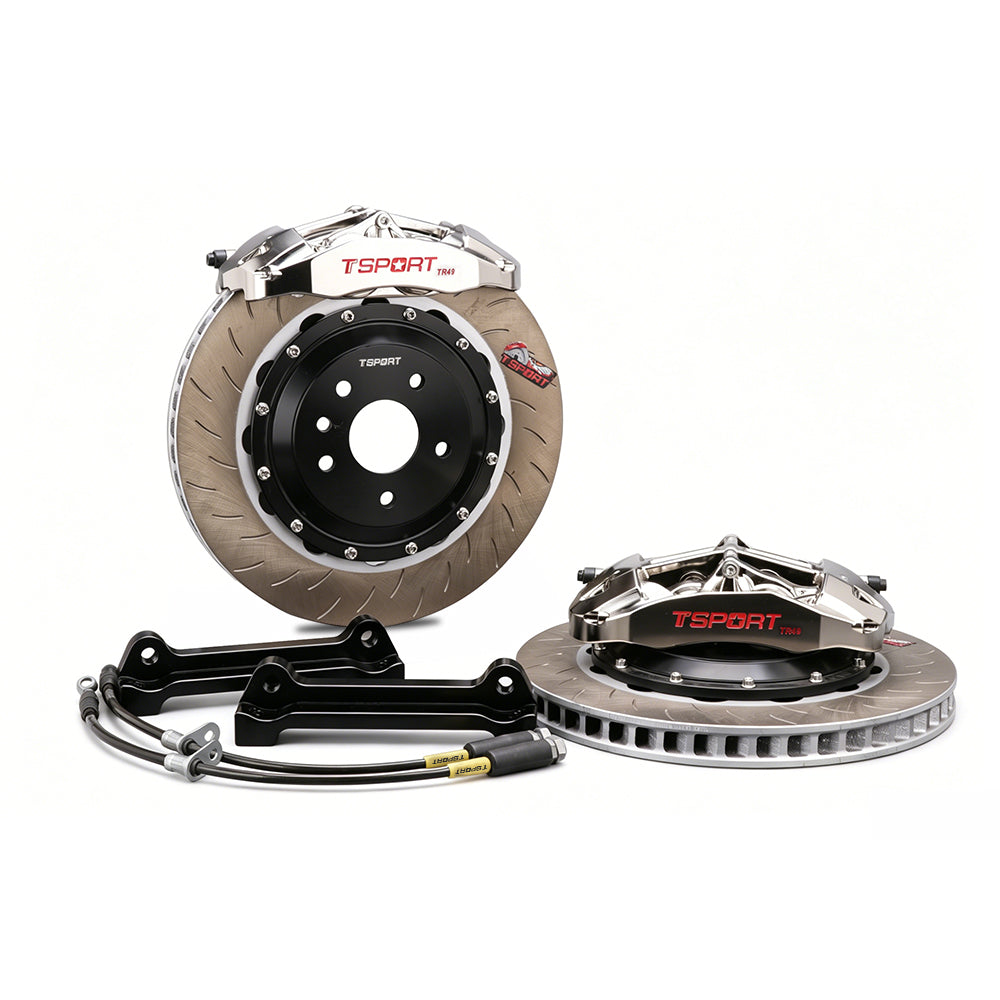
The Circuit Racing TR49 is a rear-axle 4-piston big brake kit built for circuit work, time attack, and endurance use. A monoblock forged caliper, two-piece floating rotors, and racing pad compounds deliver consistent pedal feel and thermal repeatability lap after lap.
Rear brake balance is what keeps a chassis stable under trail braking and corner entry. The TR49 pairs 28 mm and 34 mm staggered pistons with a 30.80 cm² total piston area to give a controllable rear bias without overpowering the front. Combined with a 355 or 380 mm rotor, it lets you dial in proportioning for slicks, R-comps, or street tires.
Designed to support stable trail braking, corner entry behavior, and rear brake balance without overpowering the front axle.
Monoblock forged aluminum caliper, 2.40 kg per side, built for stiffness and repeatable pedal response.
28 mm × 2 and 34 mm × 2 piston layout supports even pad wear and progressive bite.
Racing pistons without dust boots are designed for high-temperature service and fast race-weekend inspection.
Ø355 or Ø380 mm × 32 mm two-piece internally vented rotors with directional vanes.
Replaceable iron rings, top-access pad changes, open-back pistons, and accessible bleeders support real pit workflow.
| ブレーキキャリパー | ||
|---|---|---|
| シリーズ | レーシングシリーズ — サーキット | |
| モデル / 適合 | TR49 | |
| アクスル位置 | リア | |
| ピストン数 | 4ピストン | |
| ピストンタイプ | ダストブーツなしのレーシングピストン | |
| ピストン径 | 28 mm × 2 / 34 mm × 2 | |
| キャリパー寸法 | 258.8 mm × 157.7 mm × 75.2 mm | |
| ピストン総面積 | 30.80 cm² per caliper | |
| 製造プロセス | モノブロック鍛造アルミボディ | |
| 正味重量 | 2.40 kg per caliper, without pads | |
| 表面仕上げ | ニッケルメッキ | |
| カスタムカラー | Not available on this caliper | |
| 推奨ホイールサイズ | 18インチ以上 | |
| 推奨ローターサイズ | Ø355~380 mm × 32 mm | |
| ブレーキローターオプション | ||
| ローターオプション | スタンダード | オプションB レーシング |
| ローター素材 | 熱処理高炭素鋳鉄 | レーシンググレード熱処理高炭素鋳鉄 |
| アクスル位置 | リア | リア |
| ローター寸法 | Ø355 / 380 mm × 32 mm | Ø355 / 380 mm × 32 mm |
| 構造 | 2ピースローターアッセンブリ | 2ピースローターアッセンブリ |
| ベンチレーション | 内部ベンチレーション | 内部ベンチレーション |
| ローター用ハット | 車種別アルミローターキャップ | 車種別アルミローターキャップ |
| ローター取付方式 | Fixed or floating, by size and application | Fixed or floating, by size and application |
| 方向性設計 | はい — 左右専用 | はい — 左右専用 |
| ローター表面パターン | 曲面スリット / グレインスロット / ウェーブスロット / ドリルド&スリット | ウェーブスロット |
| ブレーキパッドオプション | ||
| パッドオプション | スタンダード | オプションB レーシング |
| 対応ローター材質 | アイアン/スチールローター専用 | アイアン/スチールローター専用 |
| 使用温度範囲 | 0~600℃ | 0–750 °C |
| 平均摩擦係数 | μ ≈ 0.38, varies with temp, pressure, rotor | μ ≈ 0.45, varies with temp, pressure, rotor |
| おすすめの用途 | HPDE, autocross, aggressive street use | Sustained circuit and endurance sessions where heat soak is the limiting factor |
| ライン、ブラケット&サービス | ||
| ブレーキライン構造 | 3層強化構造 | |
| ブレーキライン材質 | PTFEインナーライナー / SUS304ステンレスブレード / PVCアウターシース | |
| キャリパー取付タイプ | 車両専用キャリパーブラケットによるラジアルマウント | |
| キャリパーブラケット | Vehicle-specific caliper brackets | |
| ブレーキライン継手タイプ | 車種別専用。キャリパー側・シャシー側のフィッティングは適合車種により異なる | |
| ベッドイン(慣らし)手順 | Required before track use | |
Rear pad selection should typically run a half-step softer or cooler than the front to maintain stable rotation under brake. Match Option B rear pads with similar or higher-temp front pads to keep the car balanced.
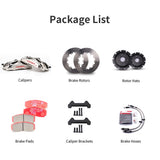
2 × TR49 rear monoblock forged 4-piston calipers with nickel-plated finish.
Brake pads for both rear calipers, selected from 0–600 °C standard compound or 0–750 °C Option B racing compound.
2 × two-piece internally vented rear rotors, Ø355 or Ø380 mm × 32 mm, left/right specific.
Vehicle-specific radial caliper brackets for correct rear caliper alignment.
車種適合のアルミ製ローターハット。リアハブ位置とローターオフセットに合わせて専用設計。
Three-layer stainless-steel braided rear brake lines with PTFE inner liner, SUS304 braid, and PVC outer sheath.
Every TR49 rear circuit racing system is engineered around the vehicle’s rear knuckle, hub location, rotor hat offset, wheel barrel, spoke clearance, brake line routing, parking brake provision, and front-to-rear brake balance target. The goal is not a generic universal fit; the goal is a rear brake package that works with your chassis geometry and gives the driver repeatable pedal behavior under trail braking, corner entry, and long-session heat.
We review the chassis, rear suspension and knuckle setup, competition use, target rear brake behavior, front brake pairing, wheel package, tire compound, ABS / proportioning strategy, parking brake requirement, and whether the car uses OEM or custom rear uprights.
For OEM knuckles, provide the vehicle information, wheel specs, wheel offset, and spoke clearance data. For custom knuckles, motorsport hub conversions, or non-OE rotor offsets, provide CAD files, drawings, hub-face data, rotor mounting dimensions, or accurate bracket mounting-point measurements.
TTSPORT reviews the submitted data, confirms caliper clearance, vehicle-specific caliper bracket geometry, rotor hat offset, parking brake approach, and brake line routing before production begins.
If you are unsure whether your wheel, rear knuckle, rotor offset, parking brake layout, or brake line routing is suitable, Contact us before ordering so the engineering team can review the build details.
The kit requires an 18-inch or larger wheel. Clearance also depends on wheel offset and spoke profile. Send your wheel specs with your order and we'll confirm before shipping.
Yes. Rear-only upgrades can shift bias rearward and cause instability. Pair the TR49 with a matching front kit sized for your vehicle to keep brake balance correct.
Ø355 mm is the lighter, more wheel-friendly option and works for most rear setups. Ø380 mm adds thermal capacity for endurance and heavier cars where the rears do more work.
Yes. A proper bedding procedure is required to transfer pad material evenly to the rotor face. Skipping it causes judder, uneven deposits, and reduced pad life.
The TR49 ships in nickel-plated finish. Custom color/anodizing is not available on this caliper.
The TR49 is a service-brake caliper. Vehicles with integrated rear parking brakes typically retain the OEM e-brake setup via drum-in-hat rotors or a separate e-brake caliper, depending on application. Confirm with our team for your specific car.
Send your vehicle and wheel details and we'll spec the right rotor size, pad compound, rotor hat offset, and bracket package for your program.
Brake Kits · Fitment · Installation · Care Guide
A brake kit is not just a pair of larger calipers. Calipers, rotors, pads, hoses, brackets, rotor hats, mounting hardware, brake fluid, wheel clearance, and bedding procedure all work together as one system.
This guide explains how to confirm the right TTSPORT brake kit before ordering, what to check before installation, and how to care for the system after installation.
Do not order a brake kit by vehicle name alone. The correct kit depends on the vehicle, axle position, wheel package, driving use, and brake system layout.
Wheel Clearance & Data Disclaimer: Technical fitment data applies strictly to rotor hats and mounting brackets—not wheel geometry. Wheel compatibility specs are provided for general reference only. Insufficient wheel clearance is not covered under warranty or data accuracy claims; if clearance is insufficient, wheel spacers must be added at the customer's discretion.
Different TTSPORT brake kit series use different hardware layouts. Always confirm what the kit includes before purchase.
Use direct-mount calipers and one-piece rotors where specified. These kits do not use rotor hats or caliper brackets unless the final product page clearly states otherwise.
Use separate friction rings and rotor hats. Hat offset, ring bolt pattern, hardware style, and rotor direction must be matched correctly.
May require bespoke brackets, rotor hats, brake lines, and engineering confirmation based on knuckle, hub, wheel, and competition use.
Require extra attention to wheel clearance, tire size, vehicle load, descent control, hose routing, and dust / water exposure.
Do not assume every brake kit includes the same parts. Package contents vary by product series, vehicle application, and final order configuration.
Before finalizing the order, review the kit specification carefully. Confirm the brake kit is matched to your vehicle and wheel setup, not only to the model name.
If any part is not listed in the final order or product page, do not assume it is included.
Inspect every component before installation. Do not modify, grind, drill, stretch, force, or space brake kit components to make them fit.
Safety: Brake kits affect braking force, hydraulic sealing, heat control, wheel clearance, and vehicle stability. Do not install the kit if fitment, torque, direction, clearance, or compatibility is unclear.
Correct installation is as important as the brake kit itself. A properly engineered kit can still perform poorly if installed with dirty mounting faces, incorrect torque, poor hose routing, or trapped air in the hydraulic system.
Verify caliper centering over the rotor and confirm even pad sweep across the friction surface.
Confirm left / right rotor direction if the rotor uses directional vanes or directional face pattern.
Check brake hose length and routing at full steering lock and full suspension travel. No twisting, rubbing, stretching, or kinking.
Check caliper-to-spoke and caliper-to-barrel clearance before road use. Wheel specs are for general estimation only—clearance issues are excluded from warranty/data claims and may require user-supplied wheel spacers.
Use the correct brake fluid type and bleed the system until pedal feel is firm and consistent.
Torque all brake hardware to the specified value. Do not reuse damaged, unknown, stretched, or corroded safety-critical fasteners.
Brake pads and rotors need a controlled bedding process before full performance is available. Bedding helps create an even transfer layer on the rotor surface, improving bite, pedal consistency, and vibration resistance.
Street pads, race pads, iron rotors, two-piece rotors, and carbon ceramic rotors may require different bedding procedures. Use the procedure supplied with the specific kit.
After installation and bedding, give the system a short break-in period before aggressive use. Pedal feel, pad contact, dust output, and noise may continue to settle after the first drives.
Brake kits need regular inspection, especially after track use, off-road use, towing, mountain driving, winter salt exposure, or any brake service.
Inspect pads, rotors, fluid level, and hose condition during normal service intervals. Prioritize quiet operation, smooth pedal feel, and even wear.
Check pad thickness, rotor surface condition, and fluid condition more often. Long descents create sustained heat even without track use.
Inspect for mud, sand, stone impact, hose abrasion, dust boot damage, and caliper contamination after trail use.
Inspect pads, rotors, fluid, and hardware before and after every event. Track heat shortens service intervals.
Check rear brake temperature, hydraulic handbrake behavior, pad wear, rotor cracking, and hardware condition frequently.
Use only compatible pads and approved bedding procedures. Inspect rotor surface condition carefully and avoid incompatible friction materials.
Do not continue driving if the brake system shows any of the following symptoms. Inspect the system or contact a qualified brake technician before using the vehicle again.
Send your vehicle details, brake kit series, wheel specs, driving use, photos, and any symptoms you notice. TTSPORT will help confirm fitment, installation checks, and the correct care path for your brake kit.
購読ありがとうございます!
このメールアドレスは登録されました!