




Für zusätzliches Gewicht ausgelegt
Mehr Bremszangenfläche vorne für Fahrzeuge mit Stahlstoßstangen, Slidern, Bergungszubehör, Wasser-, Kraftstoffbehältern, Dachzelten und größeren Reifen.

E-Mail: sales@ttsport-racing.com
Währung
 AED
AED
 AFN
AFN
 ALL
ALL
 AMD
AMD
 ANG
ANG
 AUD
AUD
 AWG
AWG
 AZN
AZN
 BAM
BAM
 BBD
BBD
 BDT
BDT
 BIF
BIF
 BND
BND
 BOB
BOB
 BSD
BSD
 BWP
BWP
 BZD
BZD
 CAD
CAD
 CDF
CDF
 CHF
CHF
 CNY
CNY
 CRC
CRC
 CVE
CVE
 CZK
CZK
 DJF
DJF
 DKK
DKK
 DOP
DOP
 DZD
DZD
 EGP
EGP
 ETB
ETB
 EUR
EUR
 FJD
FJD
 FKP
FKP
 GBP
GBP
 GMD
GMD
 GNF
GNF
 GTQ
GTQ
 GYD
GYD
 HKD
HKD
 HNL
HNL
 HUF
HUF
 IDR
IDR
 ILS
ILS
 INR
INR
 ISK
ISK
 JMD
JMD
 JPY
JPY
 KES
KES
 KGS
KGS
 KHR
KHR
 KMF
KMF
 KRW
KRW
 KYD
KYD
 KZT
KZT
 LAK
LAK
 LBP
LBP
 LKR
LKR
 MAD
MAD
 MDL
MDL
 MKD
MKD
 MMK
MMK
 MNT
MNT
 MOP
MOP
 MUR
MUR
 MVR
MVR
 MWK
MWK
 MYR
MYR
 NGN
NGN
 NIO
NIO
 NPR
NPR
 NZD
NZD
 PEN
PEN
 PGK
PGK
 PHP
PHP
 PKR
PKR
 PLN
PLN
 PYG
PYG
 QAR
QAR
 RON
RON
 RSD
RSD
 RWF
RWF
 SAR
SAR
 SBD
SBD
 SEK
SEK
 SGD
SGD
 SHP
SHP
 SLL
SLL
 STD
STD
 THB
THB
 TJS
TJS
 TOP
TOP
 TTD
TTD
 TWD
TWD
 TZS
TZS
 UAH
UAH
 UGX
UGX
 USD
USD
 UYU
UYU
 UZS
UZS
 VND
VND
 VUV
VUV
 WST
WST
 XAF
XAF
 XCD
XOF
XPF
XCD
XOF
XPF
 YER
YER
Direktmontage-Serie · Vorderachse · Off-Road 6-Piston
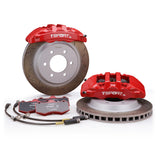
Das TTSPORT OR6 Vorderrad-Bremskit ist für beladene Toyota LC250 Prado und Lexus GX550 Overland- und Offroad-Aufbauten konzipiert — Schutz, Seilwinde, Schubladen, Dachzelt, größere Reifen und echtes Ladungsgewicht. Geschmiedete 6-Kolben-Bremssättel und Ø345 mm × 34 mm hitzebehandelte Hochkohlenstoff-Bremsscheiben sorgen für ein vorhersehbares Pedalgefühl bei langen Abfahrten, Waschbrettfahrten und gemischtem Gelände.
Mehr Bremszangenfläche vorne für Fahrzeuge mit Stahlstoßstangen, Slidern, Bergungszubehör, Wasser-, Kraftstoffbehältern, Dachzelten und größeren Reifen.
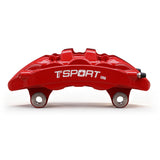
Zweiteilige geschmiedete Aluminium-Bremssättel mit einteiligen hitzebeständigen Kolben und Staubschutz sorgen für Widerstand gegen Fading bei langen Steigungen.
Toyota Land Cruiser Prado (LC250) und Lexus GX550 verwenden die OR6 Ø345 mm × 34 mm Bremsscheiben-Spezifikation.
Intern belüftete, richtungsgebundene einteilige Bremsscheiben plus Edelstahl-geflochtene Leitungen sorgen für eine konsistente Reaktion bei Staub, Schlamm und Wasserüberquerungen.
Ausgelegt, um die Bremskraft wiederherzustellen, die bei Reifen von 33–35 Zoll und schwereren Felgen verloren geht.
Die Direct-Mount-Serie verwendet fahrzeugspezifische Montagegeometrie und Bremsleitungen ohne Bremsscheibenhüte oder Bremssättelhalterungen.
| Bremssattel | |
|---|---|
| Serien | Direct-Mount-Serie |
| Modell / Anwendung | OR6 |
| Achsenposition | Vorne |
| Anzahl der Kolben | 6-Piston |
| Kolbentyp | Einteilige, hitzebeständige Kolben mit Staubschutz |
| Kolbendurchmesser | 40 mm × 4 / 43 mm × 2 |
| Bremssattelmaße | L 301 mm × B 149 mm × H 130 mm |
| Gesamt-Kolbenfläche | 79 cm² pro Bremssattel, alle Kolben zusammen |
| Herstellungsprozess | Zweiteiliger geschmiedeter Aluminiumkörper |
| Nettogewicht | 4 kg pro Bremssattel, ohne Beläge |
| Oberflächenfinish | Hochtemperatur-Glanzbeschichtung |
| Empfohlene Felgengröße | 17 Zoll oder größer |
| Empfohlene Rotorgröße | Ø340–355 mm × 32/34 mm |
| Bremsscheibe | |
| Scheibenmaterial | Hitzebehandeltes Hochkohlenstoff-Gusseisen |
| Achsenposition | Vorne |
| Rotorabmessungen für diese Anwendung | Ø345 mm × 34 mm |
| Konstruktion | Einteiliger Rotor |
| Belüftung | Intern belüftet |
| Bremsscheibenbefestigung | Fest |
| Richtungsgebundenes Design | Ja — links/rechts spezifisch |
| Bremsscheibenflächendesign | Wave Slot |
| Bremsbeläge | |
| Kompatibles Bremsscheibenmaterial | Nur Eisen-/Stahlrotoren |
| Betriebstemperaturbereich | 0–600 °C |
| Durchschnittlicher Reibungskoeffizient | Durchschnitt μ: 0,38; Schwankungen hängen von Temperatur, Liniendruck und Zustand der Bremsscheibe ab |
| Leitungen | |
| Bremsleitungskonstruktion | Dreischichtige verstärkte Konstruktion |
| Material der Bremsleitung | PTFE-Innenschicht / SUS304 Edelstahlgeflecht / PVC-Schutzummantelung |
| Bremsleitung-Verbinder | Fahrzeugspezifische Anschlüsse; Anschlüsse auf Bremssattel- und Chassisseite variieren je nach Anwendung |
| Fahrzeuganwendung & Rotorzuordnung | |
| Toyota Land Cruiser Prado (LC250) 2024-2026 | 345 mm × 34 mm |
| Lexus GX550 2024-2026 | 345 mm × 34 mm |
| Montage & Installation | |
| Primäre Fahrzeuganwendung | Toyota Land Cruiser Prado (LC250) 2024-2026 · Lexus GX550 2024-2026 |
| Modelljahre | Toyota Land Cruiser Prado LC250: 2024-2026 · Lexus GX550: 2024-2026 |
| Achse | Vorne |
| Caliper-Montagetyp | Direktmontage |
| Mindest-Raddurchmesser | 17 Zoll oder größer |
| Mindestspeichenabstand | 91 mm |
| Bremsleitung-Fitting-Typ | Fahrzeugspezifische Anschlüsse; Anschlüsse auf Bremssattel- und Chassisseite variieren je nach Anwendung |
| Einbreitverfahren | Vor dem normalen Gebrauch erforderlich |
Für Toyota Land Cruiser Prado (LC250) 2024-2026 und Lexus GX550 2024-2026 ist die korrekte Bremsscheiben-Spezifikation Ø345 mm × 34 mm. Die ältere 335 / 345 / 355 mm-Option nicht für diese Anwendung verwenden.
2 × OR6-Gusspressekolben mit 6 Kolben vorne, links/rechts-spezifisch.
Bremsbeläge für beide vorderen Bremssättel, rated 0–600 °C, geeignet für Eisen-/Stahlrotoren.
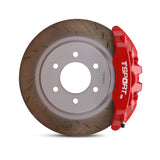
2 × einteilige Vorderrad-Bremsscheiben, Ø345 mm × 34 mm, hitzebehandelter Hochkohlenstoff-Gusseisen, intern belüftet und spezifisch für links/rechts.
2 × fahrzeugspezifische Edelstahl-Bremsleitungen mit PTFE-Innenschicht, SUS304-Geflecht und PVC-Schutzummantelung.
Fahrzeugspezifische Direkt-Montage-Hardware für die Vorderachse von Toyota LC250 Prado / Lexus GX550.
Die Direct-Mount-Serie verwendet einteilige Rotoren und Direktmontage-Bremssättel. Rotorhüte und Bremssattelhalter sind nicht enthalten, da sie bei dieser OR6-Anwendung nicht verwendet werden.
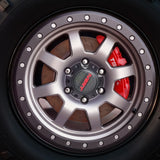
OR6 erfordert Räder ab 17 Zoll oder größer mit mindestens 91 mm Speichenabstand. Der Raddurchmesser allein reicht nicht aus; Form, Offset und inneres Barrel-Profil der Speichen müssen vor der Bestellung überprüft werden.

Es sind Räder ab 17 Zoll erforderlich.

Mindestspeichenabstand: 91 mm. Überprüfen Sie Speichenform, Offset und Innenprofil des Felgenhülsens vor der Bestellung.

Anwendung: Toyota Land Cruiser Prado (LC250) 2024-2026 und Lexus GX550 2024-2026, Vorderachse, mit Bremsscheiben-Spezifikation Ø345 mm × 34 mm.
Benötigen Sie Hilfe bei der Bestätigung der Radfreiheit oder der Kompatibilität des OR6 für Ihren LC250 Prado / GX550-Aufbau? Senden Sie vor der Bestellung Ihr Modelljahr, Ausstattung, Raddetails und Anwendungszweck.
Ja. Dieses OR6-Kit ist für die Vorderachse des Toyota Land Cruiser Prado (LC250) 2024-2026 und Lexus GX550 2024-2026 konfiguriert. Die korrekte Bremsscheiben-Spezifikation für diese Anwendung ist Ø345 mm × 34 mm.
Der OR6 ist für Räder ab 17 Zoll oder größer ausgelegt und erfordert eine minimale Speichenfreiheit von 91 mm. Nur der Raddurchmesser reicht nicht aus; Speichenform, Offset und Profil des inneren Felgenhorns müssen vor der Bestellung überprüft werden.
Ja. Dieses OR6-Kit ist für die Vorderachse des Toyota LC250 Prado und Lexus GX550 ausgelegt. Die korrekte Bremsscheiben-Spezifikation für diese Anwendung ist Ø345 mm × 34 mm.
2024-2026 Toyota Land Cruiser Prado (LC250) und 2024-2026 Lexus GX550 verwenden einteilige vordere Bremsscheiben im Ø345 mm × 34 mm-Format in der OR6 Direct-Mount-Serie. Für diese Anwendung nicht die ältere 335 / 345 / 355 mm-Option verwenden.
Nein. Dies ist eine Direct-Mount-Serie OR6-Anwendung mit einteiligen Rotoren und Direktmontage-Bremssätteln. Rotorhüte und Bremssattelhalter werden bei dieser Konfiguration nicht verwendet.
Die OR6-Bremssättel sind für die mit einem Ø345 mm × 34 mm großen Vorderrädern gelieferten Bremssättel ausgelegt und nicht dafür konzipiert, an Originalscheiben montiert zu werden.
Ja. Vor der normalen Nutzung ist eine ordnungsgemäße Einbrennprozedur erforderlich, um das Belagmaterial gleichmäßig zu übertragen und die Reibungsleistung zu stabilisieren.
Benötigen Sie Hilfe bei der Überprüfung des Radabstands oder der Kompatibilität der OR6 für Ihren LC250 Prado oder GX550 Aufbau?
Brake Kits · Fitment · Installation · Care Guide
A brake kit is not just a pair of larger calipers. Calipers, rotors, pads, hoses, brackets, rotor hats, mounting hardware, brake fluid, wheel clearance, and bedding procedure all work together as one system.
This guide explains how to confirm the right TTSPORT brake kit before ordering, what to check before installation, and how to care for the system after installation.
Do not order a brake kit by vehicle name alone. The correct kit depends on the vehicle, axle position, wheel package, driving use, and brake system layout.
Brake kits are application-specific. A visually similar kit can still have the wrong rotor offset, bracket geometry, hose fitting, caliper position, or wheel clearance requirement.
Different TTSPORT brake kit series use different hardware layouts. Always confirm what the kit includes before purchase.
Use direct-mount calipers and one-piece rotors where specified. These kits do not use rotor hats or caliper brackets unless the final product page clearly states otherwise.
Use separate friction rings and rotor hats. Hat offset, ring bolt pattern, hardware style, and rotor direction must be matched correctly.
May require bespoke brackets, rotor hats, brake lines, and engineering confirmation based on knuckle, hub, wheel, and competition use.
Require extra attention to wheel clearance, tire size, vehicle load, descent control, hose routing, and dust / water exposure.
Do not assume every brake kit includes the same parts. Package contents vary by product series, vehicle application, and final order configuration.
Before finalizing the order, review the kit specification carefully. Confirm the brake kit is matched to your vehicle and wheel setup, not only to the model name.
If any part is not listed in the final order or product page, do not assume it is included.
Inspect every component before installation. Do not modify, grind, drill, stretch, force, or space brake kit components to make them fit.
Safety: Brake kits affect braking force, hydraulic sealing, heat control, wheel clearance, and vehicle stability. Do not install the kit if fitment, torque, direction, clearance, or compatibility is unclear.
Correct installation is as important as the brake kit itself. A properly engineered kit can still perform poorly if installed with dirty mounting faces, incorrect torque, poor hose routing, or trapped air in the hydraulic system.
Verify caliper centering over the rotor and confirm even pad sweep across the friction surface.
Confirm left / right rotor direction if the rotor uses directional vanes or directional face pattern.
Check brake hose length and routing at full steering lock and full suspension travel. No twisting, rubbing, stretching, or kinking.
Check caliper-to-spoke and caliper-to-barrel clearance before road use. Wheel diameter alone is not enough.
Use the correct brake fluid type and bleed the system until pedal feel is firm and consistent.
Torque all brake hardware to the specified value. Do not reuse damaged, unknown, stretched, or corroded safety-critical fasteners.
Brake pads and rotors need a controlled bedding process before full performance is available. Bedding helps create an even transfer layer on the rotor surface, improving bite, pedal consistency, and vibration resistance.
Street pads, race pads, iron rotors, two-piece rotors, and carbon ceramic rotors may require different bedding procedures. Use the procedure supplied with the specific kit.
After installation and bedding, give the system a short break-in period before aggressive use. Pedal feel, pad contact, dust output, and noise may continue to settle after the first drives.
Brake kits need regular inspection, especially after track use, off-road use, towing, mountain driving, winter salt exposure, or any brake service.
Inspect pads, rotors, fluid level, and hose condition during normal service intervals. Prioritize quiet operation, smooth pedal feel, and even wear.
Check pad thickness, rotor surface condition, and fluid condition more often. Long descents create sustained heat even without track use.
Inspect for mud, sand, stone impact, hose abrasion, dust boot damage, and caliper contamination after trail use.
Inspect pads, rotors, fluid, and hardware before and after every event. Track heat shortens service intervals.
Check rear brake temperature, hydraulic handbrake behavior, pad wear, rotor cracking, and hardware condition frequently.
Use only compatible pads and approved bedding procedures. Inspect rotor surface condition carefully and avoid incompatible friction materials.
Do not continue driving if the brake system shows any of the following symptoms. Inspect the system or contact a qualified brake technician before using the vehicle again.
Send your vehicle details, brake kit series, wheel specs, driving use, photos, and any symptoms you notice. TTSPORT will help confirm fitment, installation checks, and the correct care path for your brake kit.
Danke fürs Abonnieren!
Diese E-Mail wurde registriert!