



Built for Real Touring Weight
Sized for trucks running armor, camping systems, recovery gear, extra fuel, and trailers.
Direct-Mount Series · Front Axle · Off-Road 6-Piston
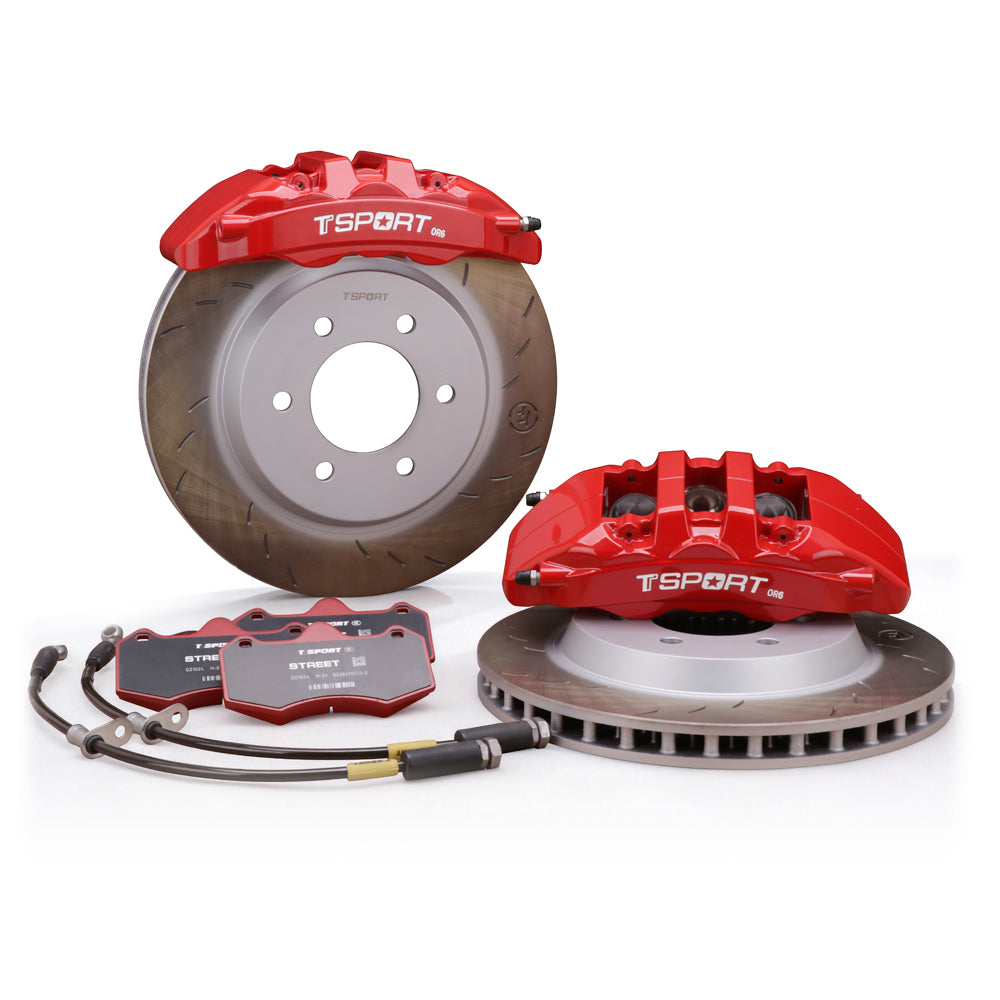
The TTSPORT OR6 front big brake kit is built for loaded Toyota Land Cruiser 300 and Lexus LX600 builds — armor, winches, long-range fuel, drawers, fridges, roof tents, trailer tongue weight, and 33–35" tire packages. A forged 6-piston direct-mount caliper, Ø345 mm × 34 mm heat-treated high-carbon rotors, stainless lines, and a high-temperature pad compound work together to keep the pedal predictable when the truck is heavy, hot, and working downhill.
Sized for trucks running armor, camping systems, recovery gear, extra fuel, and trailers.
Two-piece forged aluminum caliper, 6-piston layout, and heat-insulated pistons hold a linear pedal under sustained braking.
Toyota LC300 and Lexus LX600 use the OR6 Ø345 mm × 34 mm front rotor specification.
Direct-Mount Series uses vehicle-specific mounting geometry and brake-line fittings for the LC300 and LX600 platform.
Pad compound operates from 0–600 °C with an average friction coefficient of 0.38 for loaded highway stops, mountain passes, and trailer towing.
Internally vented, directional high-carbon rotors manage repeated heat cycles from mountain passes and washboard descents.
| Pinça de travão | |
|---|---|
| Série | Série Direct-Mount |
| Modelo / Aplicação | OR6 |
| Posição no Eixo | Dianteiro |
| Número de Pistões | 6 pistões |
| Tipo de Pistão | Pistões de uma peça com isolamento térmico e foles de proteção |
| Diâmetro do Pistão | 40 mm × 4 / 43 mm × 2 |
| Dimensões da Pinça | L 301 mm × W 149 mm × H 130 mm |
| Área Total dos Pistões | 79 cm² per caliper, all pistons combined |
| Processo de Fabrico | Corpo de alumínio forjado em duas peças |
| Peso Líquido | 4 kg per caliper, without pads |
| Acabamento de Superfície | Revestimento brilhante de alta temperatura |
| Tamanho de jante recomendado | 17 pol. ou superior |
| Tamanho do disco recomendado | Ø340–355 mm × 32/34 mm |
| Disco de Travão | |
| Material do disco | Ferro fundido de alto carbono tratado termicamente |
| Posição no Eixo | Dianteiro |
| Dimensões do Disco para Esta Aplicação | Ø345 mm × 34 mm |
| Construção | Disco de uma peça |
| Ventilação | Ventilado internamente |
| Montagem do disco | Fixo |
| Design direcional | Sim — específico para esquerda/direita |
| Padrão da face do disco | Ranhura Ondulada |
| Pastilhas de travão | |
| Material do disco compatível | Apenas discos de ferro / aço |
| Intervalo de temperatura de funcionamento | 0–600 °C |
| Coeficiente de atrito médio | μ médio: 0,38; a variação depende da temperatura, da pressão de linha e do estado do disco |
| Mangueiras | |
| Construção da mangueira de travão | Construção reforçada de três camadas |
| Material da mangueira de travão | Revestimento interior em PTFE / malha de aço inoxidável SUS304 / bainha exterior protetora em PVC |
| Racores da mangueira de travão | Racores específicos para o veículo; os racores do lado da pinça e do lado do chassis variam consoante a aplicação |
| Aplicação do Veículo e Mapeamento de Discos | |
| 2022-2026 Toyota Land Cruiser 300 (LC300) | 345 mm × 34 mm |
| 2022-2026 Lexus LX600 | 345 mm × 34 mm |
| Compatibilidade e Instalação | |
| Vehicle Application | 2022-2026 Toyota Land Cruiser 300 (LC300) · 2022-2026 Lexus LX600 |
| Anos do modelo | Toyota Land Cruiser 300 LC300: 2022-2026 · Lexus LX600: 2022-2026 |
| Eixo | Dianteiro |
| Tipo de montagem da pinça | Montagem direta |
| Tamanho Mínimo da Jante | 17 pol. ou superior |
| Folga mínima para os raios | 91 mm |
| Tipo de conexão da linha de travão | Racores específicos para o veículo; os racores do lado da pinça e do lado do chassis variam consoante a aplicação |
| Procedimento de Assentamento | Obrigatório |
For 2022-2026 Toyota Land Cruiser 300 (LC300) and 2022-2026 Lexus LX600, the correct OR6 rotor specification is Ø345 mm × 34 mm. Do not use the older 335 / 345 / 355 mm × 34 mm rotor-option layout for this application.
2 × OR6 forged 6-piston front calipers, left/right specific.
Pastilhas de travão para ambas as pinças dianteiras, classificadas para 0–600 °C e destinadas a discos de ferro/aço.
2 × one-piece front rotors, Ø345 mm × 34 mm, heat-treated high-carbon cast iron, internally vented and left/right specific.
2 × stainless-steel braided brake lines with PTFE inner liner, SUS304 braid, PVC protective outer sheath, and vehicle-specific fittings.
Vehicle-specific direct-mount hardware for Toyota LC300 / Lexus LX600 front-axle installation.
Direct-Mount Series uses one-piece rotors and direct-mount calipers. Rotor Hats and Caliper Brackets are not included because they are not used on this OR6 application.
OR6 requires 17 in or larger wheels with at least 91 mm of spoke clearance. Verify wheel clearance before install, especially if the build uses aftermarket wheels, deep spokes, or hub-side ribs.

São necessárias jantes de 17 polegadas ou maiores.

Minimum spoke clearance: 91 mm. Wheel diameter alone is not enough; spoke shape, offset, and barrel profile affect real clearance.

Application: 2022-2026 Toyota Land Cruiser 300 (LC300) and 2022-2026 Lexus LX600, front axle, with Ø345 mm × 34 mm rotor specification.
Need help confirming wheel clearance or build spec for your LC300 or LX600? Send your wheel specs and use case before ordering.
Yes. This OR6 front kit is designed for 2022-2026 Toyota Land Cruiser 300 (LC300) and 2022-2026 Lexus LX600 applications. It requires a 17-inch or larger wheel with at least 91 mm of spoke clearance.
2022-2026 Toyota Land Cruiser 300 (LC300) and 2022-2026 Lexus LX600 use Ø345 mm × 34 mm one-piece front rotors in the OR6 Direct-Mount Series. Do not use the older 335 / 345 / 355 mm option layout for this application.
No. This is a Direct-Mount Series OR6 application with one-piece rotors and direct-mount calipers. Rotor Hats and Caliper Brackets are not used on this configuration.
Yes. The pad compound operates from 0–600 °C with an average friction coefficient of 0.38, paired with internally vented, directional wave-slot rotors. The combination is built for sustained heat from loaded highway stops, mountain passes, and trailer towing.
Yes. Each kit ships with vehicle-specific stainless-steel braided lines, forged 6-piston calipers, one-piece directional rotors, pads, and the direct-mount hardware needed for the LC300 / LX600 front axle.
Yes. A proper bed-in is required to transfer pad material evenly to the rotor face and establish full friction performance. Follow the included procedure before towing or hard off-road use.
Need help confirming wheel clearance or build spec for your LC300 or LX600?
Brake Kits · Fitment · Installation · Care Guide
A brake kit is not just a pair of larger calipers. Calipers, rotors, pads, hoses, brackets, rotor hats, mounting hardware, brake fluid, wheel clearance, and bedding procedure all work together as one system.
This guide explains how to confirm the right TTSPORT brake kit before ordering, what to check before installation, and how to care for the system after installation.
Do not order a brake kit by vehicle name alone. The correct kit depends on the vehicle, axle position, wheel package, driving use, and brake system layout.
Wheel Clearance & Data Disclaimer: Technical fitment data applies strictly to rotor hats and mounting brackets—not wheel geometry. Wheel compatibility specs are provided for general reference only. Insufficient wheel clearance is not covered under warranty or data accuracy claims; if clearance is insufficient, wheel spacers must be added at the customer's discretion.
Different TTSPORT brake kit series use different hardware layouts. Always confirm what the kit includes before purchase.
Use direct-mount calipers and one-piece rotors where specified. These kits do not use rotor hats or caliper brackets unless the final product page clearly states otherwise.
Use separate friction rings and rotor hats. Hat offset, ring bolt pattern, hardware style, and rotor direction must be matched correctly.
May require bespoke brackets, rotor hats, brake lines, and engineering confirmation based on knuckle, hub, wheel, and competition use.
Require extra attention to wheel clearance, tire size, vehicle load, descent control, hose routing, and dust / water exposure.
Do not assume every brake kit includes the same parts. Package contents vary by product series, vehicle application, and final order configuration.
Before finalizing the order, review the kit specification carefully. Confirm the brake kit is matched to your vehicle and wheel setup, not only to the model name.
If any part is not listed in the final order or product page, do not assume it is included.
Inspect every component before installation. Do not modify, grind, drill, stretch, force, or space brake kit components to make them fit.
Safety: Brake kits affect braking force, hydraulic sealing, heat control, wheel clearance, and vehicle stability. Do not install the kit if fitment, torque, direction, clearance, or compatibility is unclear.
Correct installation is as important as the brake kit itself. A properly engineered kit can still perform poorly if installed with dirty mounting faces, incorrect torque, poor hose routing, or trapped air in the hydraulic system.
Verify caliper centering over the rotor and confirm even pad sweep across the friction surface.
Confirm left / right rotor direction if the rotor uses directional vanes or directional face pattern.
Check brake hose length and routing at full steering lock and full suspension travel. No twisting, rubbing, stretching, or kinking.
Check caliper-to-spoke and caliper-to-barrel clearance before road use. Wheel specs are for general estimation only—clearance issues are excluded from warranty/data claims and may require user-supplied wheel spacers.
Use the correct brake fluid type and bleed the system until pedal feel is firm and consistent.
Torque all brake hardware to the specified value. Do not reuse damaged, unknown, stretched, or corroded safety-critical fasteners.
Brake pads and rotors need a controlled bedding process before full performance is available. Bedding helps create an even transfer layer on the rotor surface, improving bite, pedal consistency, and vibration resistance.
Street pads, race pads, iron rotors, two-piece rotors, and carbon ceramic rotors may require different bedding procedures. Use the procedure supplied with the specific kit.
After installation and bedding, give the system a short break-in period before aggressive use. Pedal feel, pad contact, dust output, and noise may continue to settle after the first drives.
Brake kits need regular inspection, especially after track use, off-road use, towing, mountain driving, winter salt exposure, or any brake service.
Inspect pads, rotors, fluid level, and hose condition during normal service intervals. Prioritize quiet operation, smooth pedal feel, and even wear.
Check pad thickness, rotor surface condition, and fluid condition more often. Long descents create sustained heat even without track use.
Inspect for mud, sand, stone impact, hose abrasion, dust boot damage, and caliper contamination after trail use.
Inspect pads, rotors, fluid, and hardware before and after every event. Track heat shortens service intervals.
Check rear brake temperature, hydraulic handbrake behavior, pad wear, rotor cracking, and hardware condition frequently.
Use only compatible pads and approved bedding procedures. Inspect rotor surface condition carefully and avoid incompatible friction materials.
Do not continue driving if the brake system shows any of the following symptoms. Inspect the system or contact a qualified brake technician before using the vehicle again.
Send your vehicle details, brake kit series, wheel specs, driving use, photos, and any symptoms you notice. TTSPORT will help confirm fitment, installation checks, and the correct care path for your brake kit.
Obrigado por subscrever!
Este endereço de correio eletrónico já foi registado!