




Repeatable Lap-After-Lap Braking
Built for circuit, time-attack, drift, and rally use where pedal consistency matters from out-lap to checker.

Email: sales@ttsport-racing.com
Currency
 AED
AED
 AFN
AFN
 ALL
ALL
 AMD
AMD
 ANG
ANG
 AUD
AUD
 AWG
AWG
 AZN
AZN
 BAM
BAM
 BBD
BBD
 BDT
BDT
 BIF
BIF
 BND
BND
 BOB
BOB
 BSD
BSD
 BWP
BWP
 BZD
BZD
 CAD
CAD
 CDF
CDF
 CHF
CHF
 CNY
CNY
 CRC
CRC
 CVE
CVE
 CZK
CZK
 DJF
DJF
 DKK
DKK
 DOP
DOP
 DZD
DZD
 EGP
EGP
 ETB
ETB
 EUR
EUR
 FJD
FJD
 FKP
FKP
 GBP
GBP
 GMD
GMD
 GNF
GNF
 GTQ
GTQ
 GYD
GYD
 HKD
HKD
 HNL
HNL
 HUF
HUF
 IDR
IDR
 ILS
ILS
 INR
INR
 ISK
ISK
 JMD
JMD
 JPY
JPY
 KES
KES
 KGS
KGS
 KHR
KHR
 KMF
KMF
 KRW
KRW
 KYD
KYD
 KZT
KZT
 LAK
LAK
 LBP
LBP
 LKR
LKR
 MAD
MAD
 MDL
MDL
 MKD
MKD
 MMK
MMK
 MNT
MNT
 MOP
MOP
 MUR
MUR
 MVR
MVR
 MWK
MWK
 MYR
MYR
 NGN
NGN
 NIO
NIO
 NPR
NPR
 NZD
NZD
 PEN
PEN
 PGK
PGK
 PHP
PHP
 PKR
PKR
 PLN
PLN
 PYG
PYG
 QAR
QAR
 RON
RON
 RSD
RSD
 RWF
RWF
 SAR
SAR
 SBD
SBD
 SEK
SEK
 SGD
SGD
 SHP
SHP
 SLL
SLL
 STD
STD
 THB
THB
 TJS
TJS
 TOP
TOP
 TTD
TTD
 TWD
TWD
 TZS
TZS
 UAH
UAH
 UGX
UGX
 USD
USD
 UYU
UYU
 UZS
UZS
 VND
VND
 VUV
VUV
 WST
WST
 XAF
XAF
 XCD
XOF
XPF
XCD
XOF
XPF
 YER
YER
Racing Series · Circuit · Front Axle · 4-Piston
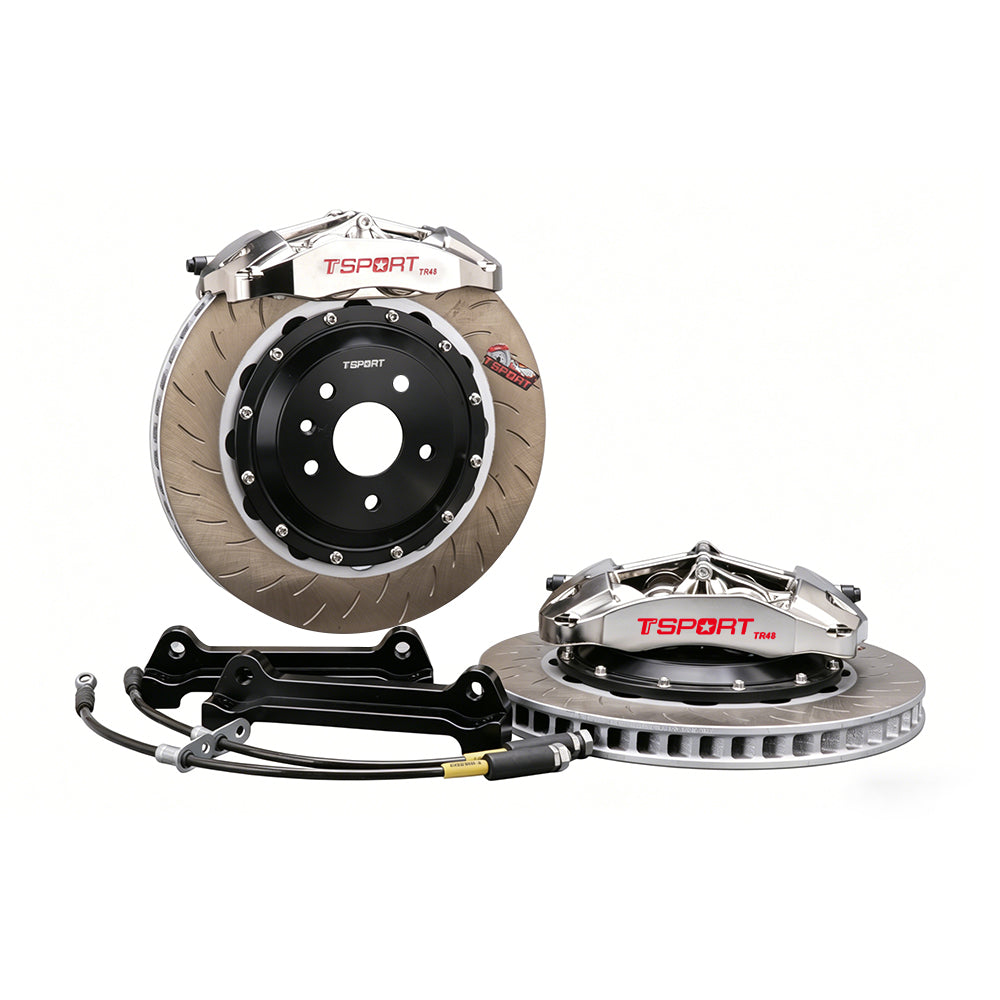
A front-axle 4-piston monoblock BBK engineered for circuit, time-attack, drift, and rally use. Forged caliper, two-piece directional rotors, and a wide pad window deliver thermal repeatability and a consistent pedal from out-lap to checker.
The TR48 caliper body is forged from a single aluminum billet for stiffness under sustained line pressure. Four pistons, 38 mm × 2 and 41 mm × 2, generate 49.36 cm² of total clamp area per caliper, with a staggered bore layout that promotes even pad pressure distribution and a more linear bite as pad temperature climbs. Racing-spec pistons run without dust boots to clear hot brake gases on track.
Built for circuit, time-attack, drift, and rally use where pedal consistency matters from out-lap to checker.
Forged from a single aluminum billet for stiffness under sustained line pressure.
38 mm × 2 and 41 mm × 2 pistons generate 49.36 cm² total piston area per caliper.
Ø355 or Ø380 mm × 32 mm two-piece rotors with internal ventilation and left/right specific directional vanes.
Standard 0–600 °C pads for sprint and HPDE, or Option B 0–750 °C pads for endurance heat loads and aggressive circuit work.
Stainless braided lines, vehicle-specific brackets, rotor hats, and required bedding instructions support a real track workflow.
| Brake Caliper | ||
|---|---|---|
| Series | Racing Series — Circuit | |
| Model / Application | TR48 | |
| Axle Position | Front | |
| Piston Count | 4-piston | |
| Piston Type | Racing pistons without dust boots | |
| Piston Diameter | 38 mm × 2 / 41 mm × 2 | |
| Caliper Dimensions | 258.8 mm × 157.7 mm × 75.2 mm | |
| Total Piston Area | 49.36 cm² per caliper | |
| Manufacturing Process | Monoblock forged aluminum body | |
| Net Weight | 2.36 kg per caliper, without pads | |
| Surface Finish | Nickel-plated | |
| Recommended Wheel Size | 18 in or larger | |
| Recommended Rotor Size | Ø355–380 mm × 32 mm | |
| Brake Rotor Options | ||
| Rotor Option | Standard | Option B Racing |
| Rotor Material | Heat-treated high-carbon cast iron | Racing-grade heat-treated high-carbon cast iron |
| Axle Position | Front | Front |
| Rotor Dimensions | Ø355 / 380 mm × 32 mm | Ø355 / 380 mm × 32 mm |
| Construction | Two-piece rotor assembly | Two-piece rotor assembly |
| Ventilation | Internally vented | Internally vented |
| Rotor Hats | Application-specific alloy rotor hats | Application-specific alloy rotor hats |
| Rotor Mounting | Fixed or floating, depending on rotor size and vehicle application | Fixed or floating, depending on rotor size and vehicle application |
| Directional Design | Yes — left/right specific | Yes — left/right specific |
| Rotor Face Pattern | Curved slot / Grain slot / Wave slot / Drilled and slotted | Wave slot |
| Recommended Use | Sprint sessions, HPDE, dual-purpose street / track cars driven to events | Sustained high-temperature work, time attack, endurance racing |
| Brake Pad Options | ||
| Pad Option | Standard | Option B Racing |
| Compatible Rotor Material | Iron / steel rotors only | Iron / steel rotors only |
| Operating Temperature | 0–600 °C | 0–750 °C |
| Average Friction Coefficient | μ ≈ 0.38 | μ ≈ 0.45 |
| Recommended Use | Strong sprint and HPDE compound | Built for endurance heat loads and aggressive circuit work |
| Lines, Brackets & Service | ||
| Brake Line Construction | Three-layer reinforced | |
| Brake Line Material | PTFE inner liner / SUS304 braid / PVC outer sheath | |
| Caliper Mounting | Radial mount with vehicle-specific caliper brackets | |
| Caliper Brackets | Vehicle-specific caliper brackets | |
| Brake Line Fittings | Vehicle-specific, caliper-side and chassis-side vary | |
| Wheel Clearance | Minimum 18 in wheels; final clearance depends on wheel barrel, spoke geometry, rotor size, and bracket package | |
| Bedding-In Procedure | Required | |
Friction values vary with temperature, line pressure, and rotor condition. Choose the compound that matches your session length and chassis weight. Pads on this platform are designed for iron / steel rotor faces only. Do not use carbon-ceramic-only compounds.
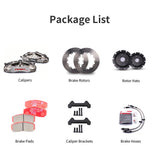
2 × TR48 front monoblock forged 4-piston calipers with nickel-plated finish.
Brake pads for both front calipers, selected from standard 0–600 °C or Option B 0–750 °C pad window.
2 × two-piece internally vented front rotors, Ø355 or Ø380 mm × 32 mm, left/right specific.
Vehicle-specific radial caliper brackets for correct front caliper alignment.
Application-specific alloy rotor hats matched to front hub location and rotor offset.
Stainless braided front brake lines with PTFE inner liner, SUS304 braid, and PVC outer sheath.
Every TR48 front circuit racing system is engineered around the vehicle’s front knuckle, hub location, rotor hat offset, wheel barrel, spoke clearance, brake line routing, front brake bias target, and intended motorsport use. The goal is not a generic universal fit; the goal is a front brake package that works with your chassis geometry and gives the driver repeatable pedal behavior from out-lap to checker.
We review the chassis, front suspension and knuckle setup, motorsport use, target front brake behavior, wheel package, tire compound, rear brake pairing, ABS / proportioning strategy, and whether the car uses OEM or custom front uprights.
For OEM knuckles, provide year, make, model, trim, current wheel size, intended use, and detailed wheel specifications. For custom uprights, motorsport hub conversions, or non-OE rotor offsets, provide CAD files, technical drawings, hub-face data, rotor mounting dimensions, or accurate bracket mounting-point measurements.
TTSPORT confirms rotor size, caliper clearance, vehicle-specific caliper bracket geometry, rotor hat offset, brake line fittings, pad compound, and required fitment details before production begins.
If you are unsure whether your wheel, front knuckle, rotor offset, brake balance target, or brake line routing is suitable, Contact us before ordering so the engineering team can review the build details.
The TR48 is a front-axle 4-piston monoblock big brake kit built for circuit, time-attack, drift, and rally use. It targets thermal repeatability lap after lap, a stable pedal under load, and predictable brake balance when paired with a matched rear setup.
Choose Ø355 mm × 32 mm for lighter cars, tight tracks, and 18 in wheels, or Ø380 mm × 32 mm for heavier chassis, fast circuits, and endurance heat loads. The standard pad runs 0–600 °C with avg μ 0.38; the racing-steel option runs 0–750 °C with avg μ 0.45 for sustained high-temp work.
Minimum 18 in wheels are required. Caliper envelope is 258.8 mm × 157.7 mm × 75.2 mm. Wheel barrel and spoke geometry vary, so confirm clearance against the caliper profile before ordering, especially with 380 mm rotors.
Yes. Rotors are two-piece assemblies, internally vented, with left/right specific directional vanes. Mounting is fixed or floating depending on rotor size and vehicle application. Face options include curved slot, grain slot, wave slot, and drilled-and-slotted; the racing-steel option ships wave slot.
Yes. A proper bed-in cycle is required to transfer pad material evenly to the rotor face, set initial friction, and prevent uneven deposits or judder. Follow the included procedure before any hard track sessions.
Yes. The TR48 uses radial-mount, vehicle-specific caliper brackets and vehicle-specific brake line fittings. Send your year, make, model, trim, and wheel spec through our contact page and we will confirm the correct bracket, rotor size, and line kit.
Send your year, make, model, trim, current wheel size, and intended use. We will confirm rotor size, bracket geometry, line fittings, and pad compound for your application.
Brake Kits · Fitment · Installation · Care Guide
A brake kit is not just a pair of larger calipers. Calipers, rotors, pads, hoses, brackets, rotor hats, mounting hardware, brake fluid, wheel clearance, and bedding procedure all work together as one system.
This guide explains how to confirm the right TTSPORT brake kit before ordering, what to check before installation, and how to care for the system after installation.
Do not order a brake kit by vehicle name alone. The correct kit depends on the vehicle, axle position, wheel package, driving use, and brake system layout.
Brake kits are application-specific. A visually similar kit can still have the wrong rotor offset, bracket geometry, hose fitting, caliper position, or wheel clearance requirement.
Different TTSPORT brake kit series use different hardware layouts. Always confirm what the kit includes before purchase.
Use direct-mount calipers and one-piece rotors where specified. These kits do not use rotor hats or caliper brackets unless the final product page clearly states otherwise.
Use separate friction rings and rotor hats. Hat offset, ring bolt pattern, hardware style, and rotor direction must be matched correctly.
May require bespoke brackets, rotor hats, brake lines, and engineering confirmation based on knuckle, hub, wheel, and competition use.
Require extra attention to wheel clearance, tire size, vehicle load, descent control, hose routing, and dust / water exposure.
Do not assume every brake kit includes the same parts. Package contents vary by product series, vehicle application, and final order configuration.
Before finalizing the order, review the kit specification carefully. Confirm the brake kit is matched to your vehicle and wheel setup, not only to the model name.
If any part is not listed in the final order or product page, do not assume it is included.
Inspect every component before installation. Do not modify, grind, drill, stretch, force, or space brake kit components to make them fit.
Safety: Brake kits affect braking force, hydraulic sealing, heat control, wheel clearance, and vehicle stability. Do not install the kit if fitment, torque, direction, clearance, or compatibility is unclear.
Correct installation is as important as the brake kit itself. A properly engineered kit can still perform poorly if installed with dirty mounting faces, incorrect torque, poor hose routing, or trapped air in the hydraulic system.
Verify caliper centering over the rotor and confirm even pad sweep across the friction surface.
Confirm left / right rotor direction if the rotor uses directional vanes or directional face pattern.
Check brake hose length and routing at full steering lock and full suspension travel. No twisting, rubbing, stretching, or kinking.
Check caliper-to-spoke and caliper-to-barrel clearance before road use. Wheel diameter alone is not enough.
Use the correct brake fluid type and bleed the system until pedal feel is firm and consistent.
Torque all brake hardware to the specified value. Do not reuse damaged, unknown, stretched, or corroded safety-critical fasteners.
Brake pads and rotors need a controlled bedding process before full performance is available. Bedding helps create an even transfer layer on the rotor surface, improving bite, pedal consistency, and vibration resistance.
Street pads, race pads, iron rotors, two-piece rotors, and carbon ceramic rotors may require different bedding procedures. Use the procedure supplied with the specific kit.
After installation and bedding, give the system a short break-in period before aggressive use. Pedal feel, pad contact, dust output, and noise may continue to settle after the first drives.
Brake kits need regular inspection, especially after track use, off-road use, towing, mountain driving, winter salt exposure, or any brake service.
Inspect pads, rotors, fluid level, and hose condition during normal service intervals. Prioritize quiet operation, smooth pedal feel, and even wear.
Check pad thickness, rotor surface condition, and fluid condition more often. Long descents create sustained heat even without track use.
Inspect for mud, sand, stone impact, hose abrasion, dust boot damage, and caliper contamination after trail use.
Inspect pads, rotors, fluid, and hardware before and after every event. Track heat shortens service intervals.
Check rear brake temperature, hydraulic handbrake behavior, pad wear, rotor cracking, and hardware condition frequently.
Use only compatible pads and approved bedding procedures. Inspect rotor surface condition carefully and avoid incompatible friction materials.
Do not continue driving if the brake system shows any of the following symptoms. Inspect the system or contact a qualified brake technician before using the vehicle again.
Send your vehicle details, brake kit series, wheel specs, driving use, photos, and any symptoms you notice. TTSPORT will help confirm fitment, installation checks, and the correct care path for your brake kit.
Thanks for subscribing!
This email has been registered!